Google's AI note-taking tool NotebookLM has recently received a major update, with its video summary feature undergoing a new visual upgrade that allows users to instantly convert documents they upload into engaging videos. The core technology behind this innovation is the Nano Banana image generation model from the Gemini 2.5 Flash family. This update not only expands the video formats but also introduces six new artistic styles, greatly enhancing the fun and memorability of content presentation.
The video summary feature of NotebookLM was already capable of transforming complex documents into explanatory short videos. Now, with Nano Banana, this feature has further unlocked creative potential. After uploading notes or documents, the AI will automatically generate a narrated video, and users can choose from six visual styles, including classic modern minimalist style, whiteboard sketch simulation style, watercolor soft art style, retro print nostalgic poster style, traditional culture heritage style, paper craft three-dimensional handmade style, and anime Japanese cartoon style.
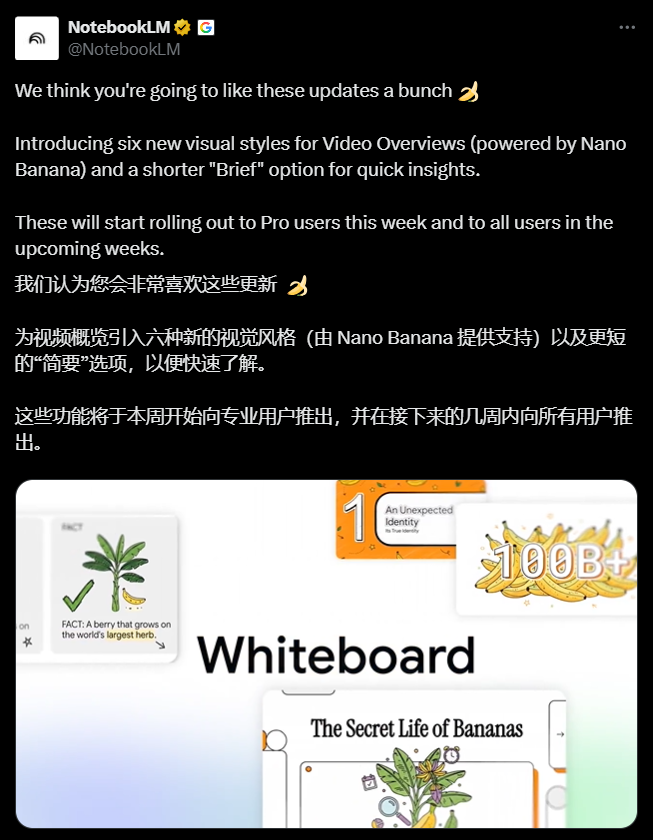
This update is first available to Pro users, who can access it by subscribing to Google AI Pro. It is expected to be available to free users within a few weeks. The generation process is efficient and convenient, completing the video in just a few minutes, from extracting key points from the document, to AI voice narration, and finally rendering stylized illustrations. As a core tool for image editing and generation, Nano Banana has processed over 5 billion AI image edits, and its integration into NotebookLM marks Google's accelerated efforts in AI multimodal tools.
Early testing shows that the anime style is particularly popular among users, transforming dry data into vivid cartoon narratives. For example, research reports can be animated into character dialogues, making them especially suitable for educational and marketing scenarios. User-shared anime-style video demonstrations show that the AI can intelligently capture the context of the document and generate coherent visual sequences, although stability still presents challenges, with some frames experiencing distortion or blurred details, especially when dealing with highly complex content.
Feedback from Chinese users has focused more on language processing issues. Nano Banana often causes confusion between dialects or produces unnatural outputs when generating Chinese videos, affecting the smoothness of viewing. For example, after importing a Chinese PDF, the anime-style video had lively visuals, but the voiceover and subtitles were not well synchronized, occasionally resulting in mixed Chinese and English. This is related to the current optimization focus of Nano Banana being primarily on English. Google has stated that it will improve multilingual support through iterations. In comparison, the whiteboard and watercolor styles are more stable and better suited for professional presentations.
This update is not just for entertainment; it strengthens NotebookLM's core positioning of simplifying complexity. Students can quickly review textbooks using the anime style, while professionals can use the retro print style to create report presentations. Combined with the newly added brief and explanation formats, users can specify key chapters or topics to further customize the output content.
Community opinions suggest that the integration of Nano Banana has elevated NotebookLM from a note-taking assistant to a visual creation tool. However, they also remind users to pay attention to the ethical boundaries of AI-generated content, such as style consistency and cultural sensitivity. With future integrations with Photos and Lens, the application ecosystem of Nano Banana will become even broader.
NotebookLM's recent upgrade demonstrates new possibilities for AI tools in the field of content creation. The anime style especially appeals to younger user groups, but the instability of Chinese support highlights the challenges of localization for global AI products. Although the technology is powerful, to truly serve users from different linguistic and cultural backgrounds, continuous optimization is still needed. It is recommended that Chinese users try the whiteboard style first, while Pro subscribers can experiment with different styles to find the most suitable option. With Google's continuous iterations, NotebookLM has the potential to become a more mature AI visual creation platform.