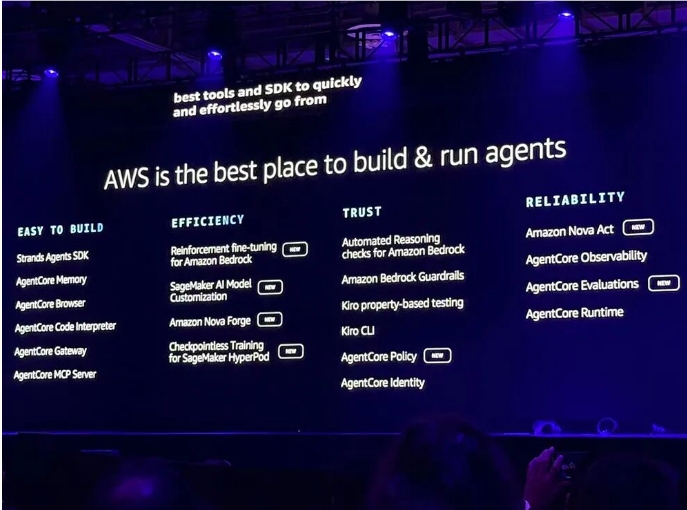
AWS re:Invent 2025 entered its third day, with Swami Sivasubramanian, Vice President of AWS Agentic AI, announcing nine new agent-related features in the main venue. These features cover SDK, runtime, security policies, and training costs, aiming to allow developers to "deploy an agent into production within ten minutes."
1. Strands Agents SDK gets a major upgrade
- Added TypeScript package, allowing front-end engineers to build agents without switching to Python
- Supports ARM and x86 edge devices; official demonstration runs a real-time path planning agent on a vehicle chip with latency < 100ms
2. Amazon Bedrock AgentCore platform launches three features
- Guardrail Policies: Set API call and data access boundaries for agents; automatically block and return audit logs when violations occur
- Online Evaluation: Output task success rate, token cost, and response delay per second, helping DevOps optimize in real time
- Contextual Memory: Retain user history across sessions; MemoryUnit encrypted storage with 30-90 days auto-expiration setting
3. SageMaker AI training introduces "no checkpoint" feature
- Eliminate traditional checkpoint saving, using streaming snapshots; training a 100B model can save about 40% storage cost and 15% total time
- Complementary reinforced fine-tuning (Reinforced Fine-Tuning) API integrates Reward Model and SFT into one job, reducing code volume by 60%
4. Full-chain security and compliance
- Default integration of AWS KMS and IAM Roles for agent workflows, supporting SOC2, ISO27001 one-click templates
- New "Agent Activity Ledger" blockchain-like tamper-proof log, used for high-compliance scenarios such as finance and healthcare
5. Edge and cloud-native deployment
- The same agent image can be directly deployed to robots or vehicle gateways through AWS Greengrass, with automatic synchronization of weights between cloud and edge
- Integrated with EKS Blueprints, use kubectl apply to scale agent pods to thousands of nodes
AWS data shows that using the new SDK + AgentCore combination, companies can move a prototype agent into production within two weeks, with an average iteration cycle shortened by 55%. Swami stated in his speech: "An agent should not be a demo, but an observable, scalable, and profitable production system."
Market analysis suggests that Amazon's "nine launches" aim to lower the threshold for agent development and operations, countering Microsoft OpenAI's GPTs ecosystem. With TypeScript support and edge runtime implementation, front-end and embedded developers will be quickly attracted, potentially leading to a new wave of "mass development" in the agent market.