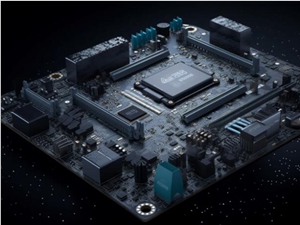
During the 2026 GTC conference, NVIDIA officially announced the launch of its "Space Computing Service" initiative, aimed at bringing data center-level AI inference capabilities into low Earth orbit. This move marks NVIDIA's computing footprint officially extending from the ground to outer space, providing the foundational power for satellite constellations and autonomous space stations.
Core Technology: Customized Solutions for Extreme Environments
Considering the strict constraints on size, weight, and power (SWaP) in space environments, NVIDIA introduced a dedicated hardware combination:
Space-1 Vera Rubin Module: This is the core component of the platform. Compared to the H100 GPU, the Rubin architecture offers up to 25 times higher AI computing performance in space environments.
IGX Thor and Jetson Orin: These two platforms are specifically designed for edge-side operations, providing stable edge AI inference performance in resource-limited orbital environments.
NVIDIA founder Jensen Huang stated that as more satellites are deployed in space, intelligence must exist where data is generated. By performing AI processing directly in orbit, satellites will no longer be simple signal transmission tools but rather "orbital data centers" capable of real-time perception, decision-making, and autonomous navigation.
The launch of this service will greatly empower geospatial intelligent analysis and complex autonomous space operations, reducing latency caused by data transmission between space and the ground. NVIDIA is working with global aerospace partners to jointly define industry standards for space computing, the "last frontier."