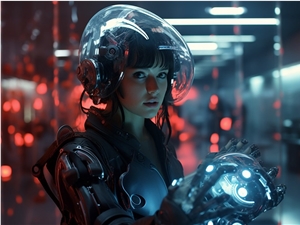
If you've watched videos recently, you should be able to clearly feel that our social media has been "invaded" by AI short dramas.
Now, out of every three videos you see, at least two are made by AI.
Moreover, the quality of AI short dramas has visibly improved a lot.
No longer are they crude and easily identifiable as AI-made, but rather they have stories, plots, special effects, and content that people can watch.

The data from the AI short drama market is also very direct:
Among the micro-short dramas launched in the first quarter of 2026, the proportion made by AI has already exceeded 95%.
In the first half of 2026, the total playback volume of AI short dramas across the web has surpassed 15 billion times.
To better understand the terrifying nature of this number, we can compare it with the top 10 most watched series on Netflix—
Their combined playback volume is only 690.8 million times.

This number hides a simple reason:
AI can make genres that real-life short dramas cannot afford.
Fantasy, xianxia (immortal heroes), science fiction, reincarnation stories, system flow... These types that require a lot of special effects and scenes used to be too expensive for people to consider.
Now, a short drama that originally needed 300,000 yuan for real actors can be made with AI for just 3,000 yuan.

All aspects including picture quality, special effects, character consistency, and voice acting meet the standards, and the cost is reduced to one-tenth or even lower than before.
Individual creators and small teams can shine and even receive invitations from Hollywood directors.

Many people ask me: Can ordinary people make AI short dramas?
Yes.
I have been using a platform called Judaxia recently.
This is a one-stop creative platform for AI short dramas, built based on the workflow of many real AI short drama teams.
From script generation, character setting, intelligent storyboard, video generation to team collaboration, everything can be done on this website.
https://www.judaxia.art/

Previously, my process for making AI short dramas was like this:
Writing scripts in A tool
Generating characters in B tool
Running storyboards in C tool
Producing videos in D tool
Finally editing
Now, I can directly build a complete workflow through Judaxia:
Script generation or script upload
Preparing character, scene, and prop materials
Intelligent storyboard breakdown
Generating storyboard images
Generating storyboard videos
Reusing materials and project management
Team collaboration and task progress
I tested it, and from generating a script to getting a complete storyboard video, one episode of about 10 minutes can be completed quickly.

Script creation
Viewers watching short dramas always focus on the watchability of the story.
Whether a short drama can become popular depends mainly on the story itself.
If you're a beginner, you might not know how to structure a script, nor how to turn an idea into an executable script.
At this time, Judaxia's AI script creation function is very friendly for beginners.

Just input the short drama theme or story outline, and the AI can generate a complete script, including episodes, scenes, characters, and dialogues.
Whether it's urban rising, ancient style power strategies, emotional twists, or comic adaptations, it can all be completed in minutes.

If you already have a polished script, you can also upload it to Judaxia, letting the AI intelligently break it down.
After breaking down the script, we can start creating the video officially.
Currently, Judaxia supports over a dozen styles such as realistic human, female sweet, Japanese anime, 3D CG, and fantasy thick painting, covering almost all popular short drama styles in the market.

Intelligent storyboard design
In the production of AI short dramas, the storyboard is a crucial step.
Judaxia can intelligently break down the script into executable shots, clearly defining characters, actions, scenes, props, emotions, and compositions in each shot.
The clearer the storyboard, the more stable the subsequent video generation, greatly saving the creator's time.

AI video generation
Anyone who has made AI videos knows that the strength of the underlying model directly affects the quality of the final product.