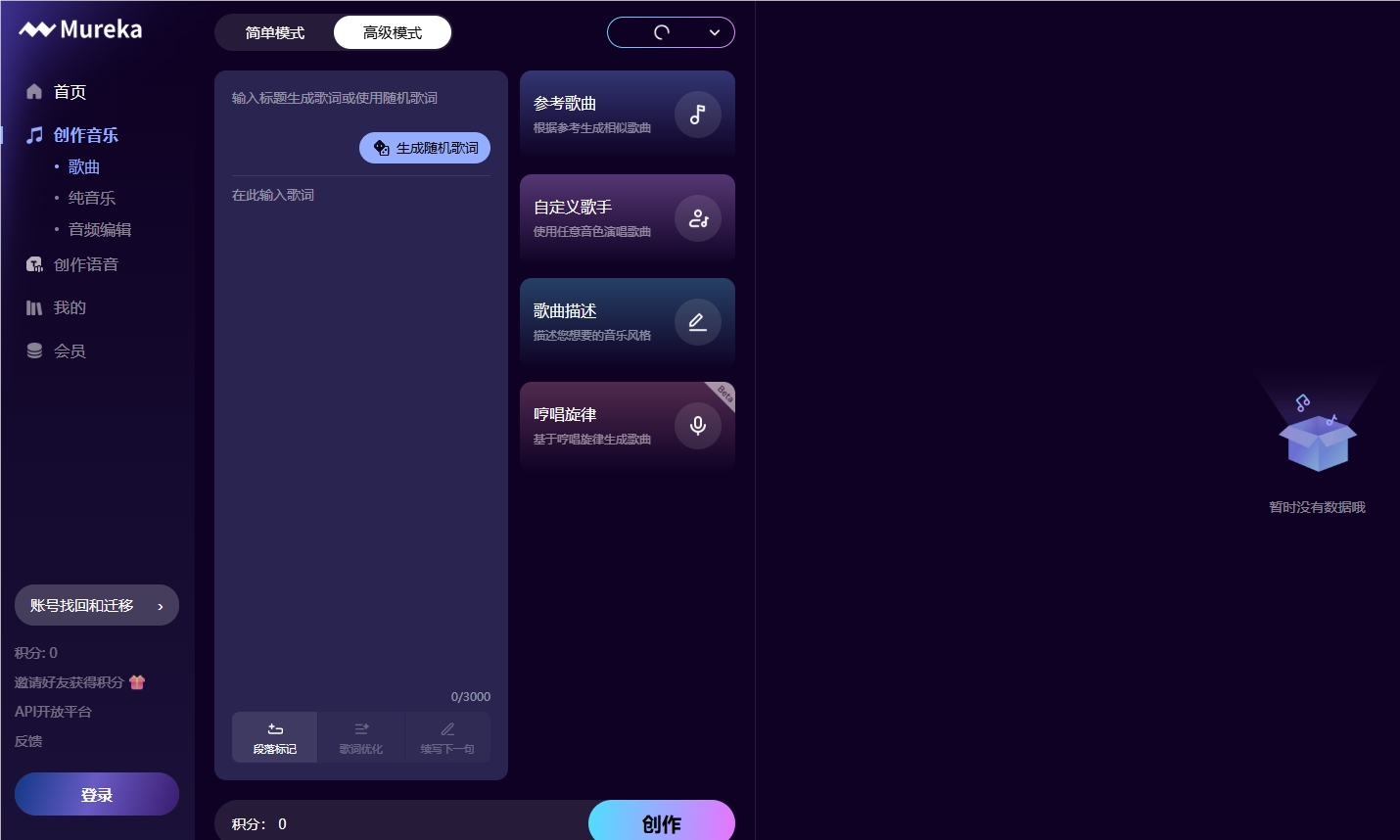
Kunlun Wanyi officially launched its new AI music generation model, Mureka V9.5 today. This version abandons the current industry's common "high volume, high saturation, strong stimulation" competition path, and instead emphasizes "restraint, blank space, and naturalness," aiming to solve the long-standing "mechanical feel" problem in AI music, making the generated music truly have a "human touch" and stand up to repeated listening.

The core upgrade of Mureka V9.5 lies in the deepening of its self-developed MusiCoT (Music Chain of Thought) framework. Unlike previous AI that directly generates audio waveforms, V9.5 first builds a strict "music thought process" before generating, planning the complete logic from macro musical structure to micro note expression. This allows the model to "do more with less": arrangements no longer constantly overload, but leave "breathing space" for melody and emotion; the evolution of sections is more in line with human creative logic, significantly reducing template stacking.
According to internal evaluation data, V9.5 has achieved significant breakthroughs in key indicators: the pass rate of vocal performance has risen to 61.0%, and the expression of breath and emotion is closer to that of real people; the pass rate of prompt control is as high as 97.0%, and the proportion of completely reflecting the style reaches 95.7%, meaning the model can better execute the creator's intention, rather than covering up logical deficiencies with complex instrumentation.

Notably, V9.5's performance in the Chinese traditional music field is truly "transformative." The new model has greatly improved the accuracy of Chinese pronunciation, solving the problem of unclear long sentences; at the same time, the handling of breath and emotional fluctuations is more natural, completely leaving behind the "synthetic feeling" commonly found in traditional Chinese AI music. In addition, the model has optimized the balance between harmony and melody, accurately restoring the essence of national instrumentation, and refusing to simply pile up "Chinese-style" elements.
Kunlun Wanyi stated that the evolutionary direction of V9.5 directly comes from over 25,000 genuine user feedback from around the world. User needs clearly point toward "stronger consistency in long passages, more realistic vocals, and music that truly sounds human." This marks that Mureka is evolving from a mere "generation tool" into an inspiration catalyst and a part of professional workflow.
Looking back at Mureka's development: the V8 version achieved "AI music can be released," the V9 version achieved "fine control," while V9.5 has given AI music the "soul" to be worth listening to repeatedly. Currently, Mureka V9.5 is open to global users. Overseas users can visit mureka.ai, and domestic users can visit mureka.cn to experience it.